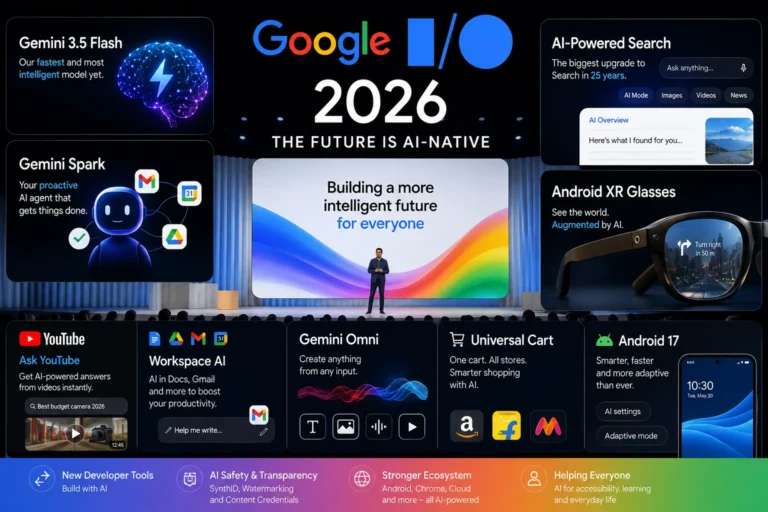
Google I/O 2026 showcased a shift toward an AI-integrated ecosystem, moving beyond traditional software updates. The event introduced faster Gemini models and a conversational redesign of Search. These advancements aim to transform Google from a search-oriented company into a proactive AI platform embedded in daily digital tasks.
New hardware and experimental platforms aim to automate complex workflows and bridge augmented reality with daily life. Google also expanded its safety initiatives with enhanced deepfake detection and watermarking. These updates across Android and developer tools reflect a commitment to a seamless, AI-first experience across all computing devices.
The future of the internet may have shifted dramatically at Google I/O 2026. This year’s keynote was not simply another developer event filled with software updates and technical announcements. Instead, Google unveiled a bold vision where artificial intelligence becomes deeply integrated into how people search, work, communicate, shop, and even experience the real world.
From the launch of smarter Gemini AI models to futuristic Android XR smart glasses, Google made one thing clear: the company wants AI to become a constant digital companion rather than just a tool users open occasionally.
Here’s a detailed look at everything important announced during Google I/O 2026 — and why it matters beyond the headlines.
🚀 A New Era Begins With Gemini 3.5 Flash
One of the biggest announcements from the keynote was the introduction of Gemini 3.5 Flash, Google’s latest AI model designed for speed, efficiency, and real-time assistance.
Unlike earlier AI systems that mainly focused on answering prompts, Gemini 3.5 Flash is optimized for:
- Faster reasoning
- Better coding support
- Improved multitasking
- More natural conversations
- Real-time contextual understanding
Google says the model will power many of its services moving forward, including Search, Android, Workspace, and developer tools.
For everyday users, this means AI responses should feel more conversational and useful rather than robotic or generic.
What stood out during the demo was how naturally Gemini handled follow-up questions and complex tasks. Instead of giving isolated answers, the AI behaved more like an assistant that actually understands ongoing context.
🔍 Google Search Gets Its Biggest Transformation in Decades
Perhaps the most important announcement of the event was the complete redesign of Google Search.
For over two decades, Google Search worked mainly as a list of blue links. Now, the company is evolving Search into an AI-powered experience.
The new AI Search experience includes:
- Conversational search results
- AI-generated summaries
- Smart follow-up suggestions
- Visual and voice understanding
- Dynamic information cards
- Personalized context-aware responses
Users can now ask layered questions naturally, almost as if chatting with a person.
For example, instead of searching:
“Best phone under ₹30,000”
Users can ask:
“Which phone under ₹30,000 has the best battery and camera for travel photography?”
Google’s AI then analyzes reviews, comparisons, videos, and web sources to generate a smarter response.
This shift could fundamentally change how websites receive traffic in the future — something bloggers, publishers, and SEO professionals are already paying close attention to.
🤖 Gemini Spark Introduces the “AI Agent” Future
Another major reveal was Gemini Spark, Google’s experimental AI agent platform.
Unlike standard chatbots, Gemini Spark is designed to proactively help users in the background.
Google demonstrated how the AI agent could:
- Organize emails
- Schedule meetings
- Monitor flights
- Compare products
- Build workflows
- Assist with research
- Complete multi-step tasks automatically
This is a significant move toward what the tech industry calls “agentic AI” — AI systems capable of independently handling tasks with minimal human input.
During the keynote, Google repeatedly emphasized that AI should become “helpful without being intrusive.”
That balance will likely define the success or failure of AI assistants over the next few years.
👓 Android XR Smart Glasses Steal Attention
One of the most visually impressive moments of Google I/O 2026 came when Google showcased its new Android XR smart glasses.
Built in collaboration with companies like Samsung and Xreal, the glasses aim to merge augmented reality with Gemini AI assistance.
Features shown during the keynote included:
- Real-time translation
- Navigation overlays
- Hands-free messaging
- Voice-controlled AI support
- Context-aware recommendations
- Live object recognition
In one demo, the glasses translated conversations instantly between two languages while displaying subtitles directly in the user’s field of view.
The presentation strongly suggested that Google sees XR devices as the next major computing platform after smartphones.
🎥 Gemini Omni Expands AI Creativity
Google also introduced Gemini Omni, a multimodal AI system capable of generating content across different formats.
Users can now create:
- Videos from text
- Images from voice prompts
- Audio responses
- Mixed media presentations
- Interactive visual content
What makes Gemini Omni particularly interesting is its ability to combine multiple types of inputs simultaneously.
For creators, marketers, and businesses, this could dramatically simplify content production workflows.
However, it also raises important discussions around misinformation, deepfakes, and AI-generated media authenticity.
🛡 Google Pushes AI Safety and Deepfake Detection
Google acknowledged growing concerns surrounding AI-generated content and misinformation.
To address this, the company expanded its AI transparency initiatives through:
- SynthID watermarking
- Content Credentials verification
- AI-generated media labels
- Deepfake detection systems
Google says these tools are meant to help users identify whether images, videos, or audio have been generated using artificial intelligence.
As AI content becomes harder to distinguish from reality, these protections may become increasingly important.
🧑💻 Developers Receive Massive AI Upgrades
Developers were another major focus of Google I/O 2026.
Google announced new AI-powered coding tools capable of:
- Generating app layouts
- Writing code from prompts
- Fixing bugs automatically
- Explaining code logic
- Building Android apps using natural language
The company also improved Android Studio and Google AI Studio with deeper Gemini integration.
This could significantly lower the barrier to app development for beginners while helping experienced developers work faster.
📱 Android 17 Focuses on Adaptive Experiences
Although AI dominated the keynote, Google also previewed features coming to Android 17.
Key improvements include:
| Feature | Details |
|---|---|
| Better Tablet Support | Smarter adaptive layouts |
| XR Integration | Support for mixed reality devices |
| AI Features | Deeper Gemini integration |
| Camera Upgrades | Improved image processing |
| Performance | Better battery optimization |
Google appears focused on making Android work seamlessly across phones, tablets, foldables, cars, TVs, and XR devices.
💭 Why Google I/O 2026 Felt Different
Previous Google I/O events often focused on separate products and updates.
This year felt different.
Almost every announcement revolved around a single idea:
AI should become an invisible layer integrated into everyday life.
Whether it was Search, Android, Workspace, YouTube, shopping, or XR devices — Google’s ecosystem is rapidly becoming AI-first.
The company is no longer treating artificial intelligence as an optional feature. It is becoming the foundation of the entire Google experience.
📌 Final Thoughts
Google I/O 2026 may eventually be remembered as the moment Google fully transitioned from a search company into an AI platform company.
The announcements showed ambition, excitement, and also uncertainty about how quickly society will adapt to these technologies.
For users, the future promises more convenience and smarter digital experiences.
For creators and publishers, however, the evolving AI-powered web may also bring new challenges around visibility, traffic, and content discovery.
One thing is certain: after Google I/O 2026, the internet’s next chapter looks very different from the last one.
What was the biggest announcement at Google I/O 2026?
Google introduced Gemini AI upgrades, AI-powered Search, Android XR glasses, and new developer tools.
Did Google announce Android 17 at Google I/O 2026?
Yes, Google previewed Android 17 features including adaptive UI improvements and deeper AI integration.
What is Gemini Spark?
Gemini Spark is Google’s new AI agent designed to help users automate tasks across apps and services.