
Introduction: A New Generation of Redmi Powerhouses
The Redmi Note series has long stood as a benchmark for affordable flagship performance. With the Redmi Note 15 Pro Plus entering the market as the successor to the Redmi Note 14 Pro Plus, Xiaomi once again raises expectations in design, performance, and innovation.
This detailed comparison dives into every aspect — from display quality to camera performance and software upgrades — to help you decide which device is truly worth your investment in 2026.
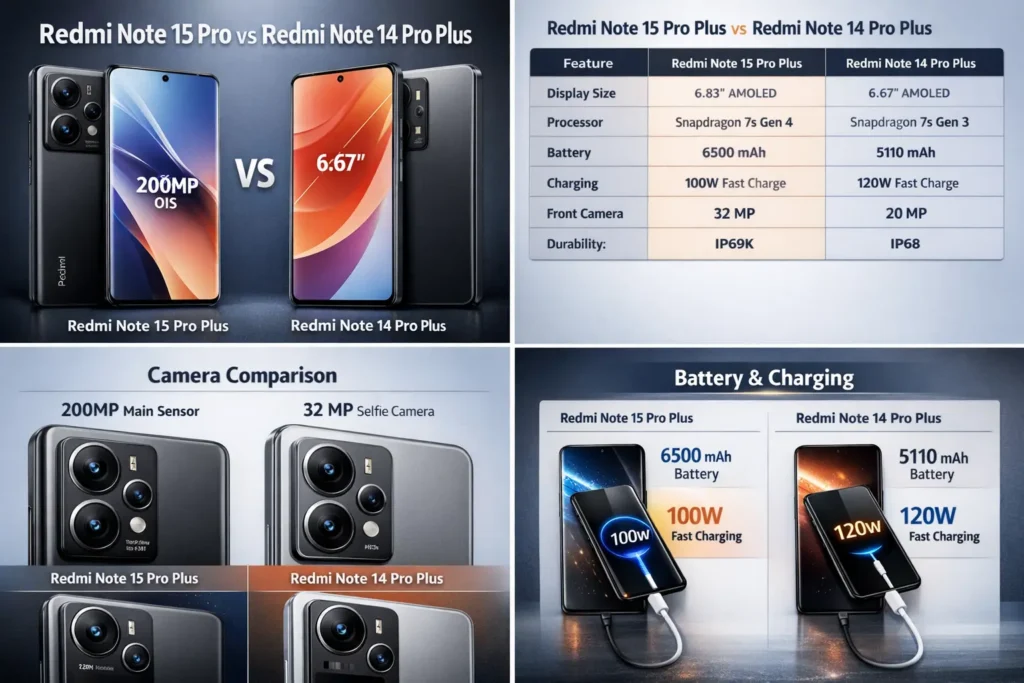
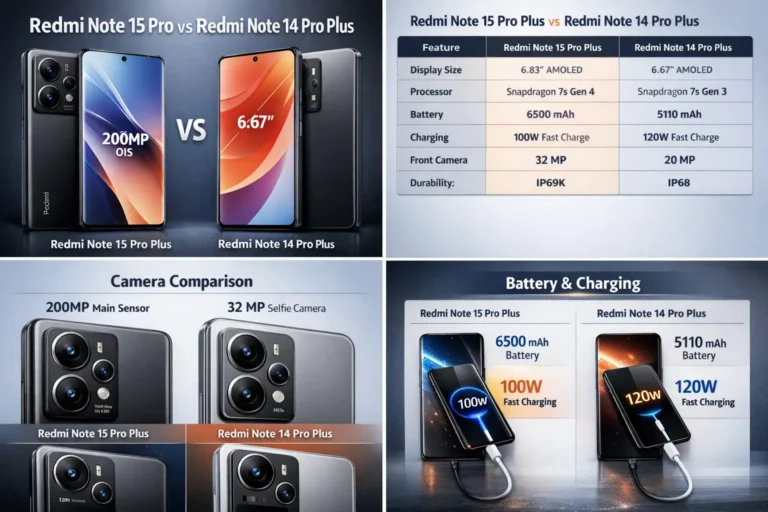
Redmi Note 15 Pro Plus vs Redmi Note 14 Pro Plus: design, camera, battery, and performance comparison
Design and Build Quality
Sleek Aesthetic Changes Between Generations
The Redmi Note 15 Pro Plus brings subtle yet premium design refinements. It now sports a curved-edge AMOLED display with a more ergonomic grip, slimmer bezels, and a frosted glass back that feels distinctly more high-end than the 14 Pro Plus.
The Redmi Note 14 Pro Plus, on the other hand, features a flat-edge design that some users may still prefer for its sturdier feel. Its rectangular camera housing continues to look modern, though the newer model’s circular module looks more aligned with 2026 flagship aesthetics.
Durability and IP Ratings: Who Wins?
The Note 15 Pro Plus makes a significant leap forward with IP69K certification, offering protection against high-pressure water jets and dust ingress — an impressive feat in the mid-range category. The Note 14 Pro Plus had IP68 certification, which was already strong but slightly less durable.
Display: Visual Experience Upgraded
Screen Size and Type
The Redmi Note 15 Pro Plus features a 6.83-inch 1.5K AMOLED display, slightly larger than the 6.67-inch panel on the 14 Pro Plus. Both models offer a 120Hz refresh rate, but the newer model provides enhanced LTPO technology, enabling smoother adaptive refresh rates.
Brightness, Resolution, and Refresh Rate
The 15 Pro Plus offers up to 1800 nits of peak brightness, outperforming the 14 Pro Plus’s 1600 nits. This makes the newer model more readable under direct sunlight and ideal for HDR streaming.
Display Protection and Design Curves
Both phones feature Gorilla Glass Victus, but the 15 Pro Plus uses a newer generation with slightly better scratch resistance. The curved-edge panel on the 15 Pro Plus adds a premium visual appeal, though it may be more prone to accidental touches compared to the flat panel of its predecessor.
Performance: Power Meets Efficiency
Processor Comparison: Snapdragon 7s Gen 4 vs Gen 3
Under the hood, the Redmi Note 15 Pro Plus runs on the Snapdragon 7s Gen 4 chipset, built on a 4nm process, offering 10–15% better CPU and GPU performance and improved thermal management over the 7s Gen 3 used in the 14 Pro Plus.
GPU and Gaming Capabilities
Gaming performance sees a noticeable boost. With an updated Adreno GPU, the 15 Pro Plus delivers more consistent frame rates in demanding titles like Call of Duty: Mobile and Genshin Impact. The thermal efficiency also prevents throttling during extended gaming sessions.
Software and User Interface: HyperOS Improvements
Both phones run HyperOS, Xiaomi’s redesigned operating system based on Android 14. However, the 15 Pro Plus benefits from longer software support (4 years of updates + 5 years of security patches), ensuring future compatibility.
Camera: Flagship-Level Optics on a Budget
Rear Camera Setup and Sensor Differences
Both devices boast a 200MP Samsung ISOCELL HP3 sensor, but the Note 15 Pro Plus uses an updated imaging algorithm and AI fusion engine, enhancing low-light performance and color accuracy. The supporting sensors — ultra-wide and macro — have also received slight tuning improvements.
Front Camera and Selfie Features
The Note 15 Pro Plus features a 32MP front-facing camera, while the 14 Pro Plus settles for 20MP. The difference is evident in sharper details, better dynamic range, and natural skin tones.
Video Recording Capabilities
Both phones support 4K recording, but the Note 15 Pro Plus introduces AI stabilization and cinematic mode, resulting in smoother video capture with richer tones.
Battery and Charging Performance
Battery Capacity Comparison
Battery life sees a major upgrade — the Note 15 Pro Plus packs a 6500 mAh battery, compared to 5110 mAh in the 14 Pro Plus. The efficiency gains from the Snapdragon 7s Gen 4 help extend screen-on time by roughly 15%.
Fast Charging Technologies: 100W vs 120W
While the older 14 Pro Plus supports 120W fast charging, the newer 15 Pro Plus opts for 100W but with better heat management. In real-world terms, both charge fully in around 25 minutes.
Storage, RAM, and Connectivity Options
Both models come with LPDDR5 RAM and UFS 4.0 storage, but the Note 15 Pro Plus starts with 12GB + 256GB, while the 14 Pro Plus offers 8GB + 256GB variants. Connectivity remains top-tier — both feature Wi-Fi 6E, Bluetooth 5.3, and 5G dual-SIM.
Audio, Haptics, and Additional Features
Dual stereo speakers with Dolby Atmos support are present on both, but the Note 15 Pro Plus introduces Hi-Res wireless audio. The in-display fingerprint sensor, X-axis haptics, and IR blaster are retained in both devices — hallmarks of Redmi’s attention to user comfort.
Pricing and Value for Money
The Redmi Note 15 Pro Plus retails at approximately ₹42,000, while the Note 14 Pro Plus now sells around ₹29,000. Although the newer model is pricier, it brings significant improvements in design, battery, and performance.
For budget-conscious users, the 14 Pro Plus remains a compelling buy, but power users and gamers will find the 15 Pro Plus a far better long-term investment.
Verdict: Should You Upgrade to the Redmi Note 15 Pro Plus?
If you’re currently using a Redmi Note 14 Pro Plus, upgrading may not be mandatory unless you crave the latest chipset, larger battery, and improved selfie camera. However, for new buyers, the Redmi Note 15 Pro Plus stands out as the best Redmi Note ever made — delivering near-flagship performance at a mid-range price.
FAQs: Redmi Note 15 Pro Plus vs Redmi Note 14 Pro Plus.
Q1. Is the Redmi Note 15 Pro Plus worth upgrading from the 14 Pro Plus?
✅ Yes, especially if you value better battery life, performance, and camera quality.
Q2. Which phone has a better camera for photography?
🔋 The Note 15 Pro Plus with its 6500 mAh battery lasts significantly longer.
Q3. Which one offers longer battery life?
🔋 The Note 15 Pro Plus with its 6500 mAh battery lasts significantly longer.
Q4. Is there any difference in software updates?
🧠 Yes, the 15 Pro Plus guarantees more years of system and security updates.
Q5. Which phone is better for gaming?
🎮 The newer Snapdragon 7s Gen 4 gives smoother performance and better cooling.
Q6. What’s the final recommendation between the two?
⭐ Go for the Redmi Note 15 Pro Plus if you want a future-proof phone; choose the 14 Pro Plus if you want solid performance at a lower cost.
Conclusion: The Future of the Redmi Note Series
The Redmi Note 15 Pro Plus vs Redmi Note 14 Pro Plus comparison showcases how Xiaomi continues to push boundaries in the mid-range smartphone segment. With enhanced durability, better power efficiency, and camera improvements, the 15 Pro Plus clearly leads — but the 14 Pro Plus still remains a fantastic value option in 2026.
🔗 External Reference:
For official specifications, visit Mi.com.